
Quantum Computing Algorithms Applications in CFD
Written by: Dr. Alon Davidy

Description
Quantum Computational Fluid Dynamics (QCFD) is an emerging field that applies quantum computing to solve the complex mathematical equations of fluid flow, primarily the Navier-Stokes equations. Traditional Computational Fluid Dynamics (CFD) is extremely resource-intensive; QCFD aims to overcome these limits by leveraging quantum properties like superposition and entanglement to potentially achieve exponential speedups in simulation time and mesh resolution. Many CFD problems rely on solving massive linear systems. Quantum Linear System Algorithms (QLSAs) like HHL can solve these significantly faster than classical methods. These algorithms may be used in Aerospace, Automotive and Energy applications.
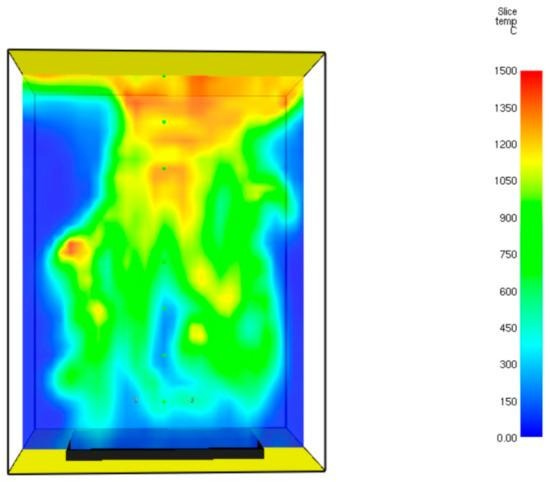
3D Temperature field (°C) of the flue gaseous mixture inside the coke burner. This image has been obtained by using FDS software
Introduction
Quantum computing for computational fluid dynamics (CFD) is an active but still immature research area. Most current work does not yet deliver practical, industrial-scale CFD on quantum hardware. Instead, the literature focuses on proof-of-concept solvers, hybrid quantum-classical workflows, lattice-Boltzmann-style formulations, and variational or machine-learning-based reduced models. Across the literature, the major obstacles are consistent: nonlinearity, dissipation, state preparation, measurement and readout, circuit depth, conditioning, and noise. The strongest near-term path appears to be hybrid acceleration of selected subproblems—especially linear systems and pressure-Poisson-like solves—rather than end-to-end replacement of classical CFD workflows. Sources: Springer review (2025); Sanavio & Succi (2024); Bharadwaj & Sreenivasan (2025)
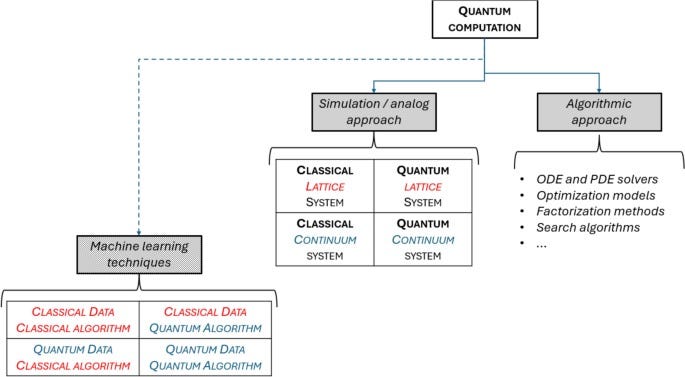
Figure 1. Classification of quantum approaches for CFD. Source: https://link.springer.com/article/10.1007/s42496-025-00269-1
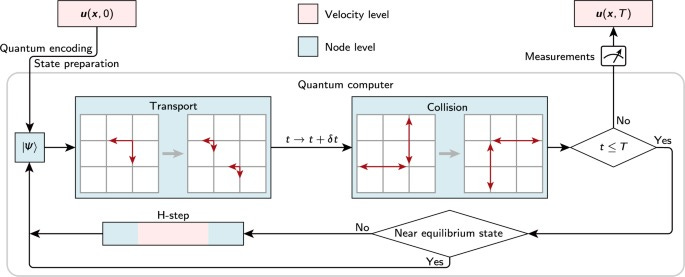
Figure 2. Flowchart for a quantum lattice Boltzmann method. Source: https://www.nature.com/articles/s41534-025-01142-6
1. Reviews and Field Overviews
Recent review papers provide a clear map of the field. Malinverno and Blasco Alberto (2025) classify quantum-CFD approaches into algorithmic methods, analogue/simulator approaches, and machine-learning-based approaches. Sanavio and Succi (2024) emphasize why fluid dynamics is intrinsically difficult for quantum computing, especially because classical fluid equations are nonlinear and dissipative while digital quantum evolution is linear and unitary. Bharadwaj and Sreenivasan (2025) provide an updated overview of algorithm families and conclude that near-term progress requires compact, shallow, end-to-end algorithms that explicitly account for hardware noise and readout overhead. Sources: Malinverno & Blasco Alberto (2025); Sanavio & Succi (2024); Bharadwaj & Sreenivasan (2025)
2. Direct Quantum Algorithms for Navier–Stokes and Nonlinear PDEs
A foundational contribution is Gaitan’s 2020 paper on finding Navier–Stokes flows through quantum computing. The paper reduces the PDE system to nonlinear ordinary differential equations after spatial discretization and then applies a quantum ODE algorithm. The demonstration case is quasi-1D inviscid compressible flow through a de Laval nozzle. The work is conceptually important because it showed how a known quantum ODE solver could be promoted to a PDE solver, but its speedup claims depend on assumptions about rough/non-smooth regimes and oracle access to the nonlinear driver. Sources: Gaitan (2020); Gaitan follow-up (2021)
This stream of work is closely related to broader linearization and embedding strategies, including Carleman-type approaches, where nonlinear fluid dynamics are transformed into higher-dimensional linear systems that are more natural for quantum algorithms. The appeal is clear, but reviews consistently note that the dimensional blow-up, truncation errors, repeated time marching, and readout costs often weaken the practical advantage once all workflow overheads are included. Sources: Sanavio & Succi (2024); Bharadwaj & Sreenivasan (2025)
3. Variational and Hybrid Quantum-Classical CFD
Variational and hybrid methods are among the most practically oriented directions in the current literature. Jaksch, Givi, Daley, and Rung (2023) present a variational quantum CFD framework based on multigrid renormalization, variational trial states, and a quantum nonlinear processing unit. Their explicit demonstration problem is 1D Burgers’ equation, but the broader objective is CFD. The paper argues that if turbulent structures can be represented using shallow, low-entanglement quantum ansatzes, then the algorithm may scale polynomially better with Reynolds number than corresponding classical methods. Sources: Jaksch et al. (2023); Open PDF
Lapworth (2022) embeds the HHL linear-systems algorithm into the SIMPLE incompressible CFD workflow for the 2D lid-driven cavity. The nonlinear updates remain classical, while the pressure-correction solve is delegated to the quantum side. This paper is especially valuable because it reveals a major practical bottleneck: the classical preprocessing needed to decompose CFD matrices into linear combinations of unitaries can dominate the total cost and may cancel any quantum advantage. Sources: Lapworth (2022)
Bharadwaj and Sreenivasan (2023) introduce QFlowS, a gate-level hybrid framework for low-Re flow problems. Their work is notable for considering not only the linear solver itself but also state preparation and in-situ post-processing of nonlinear observables. Similarly, Song et al. (2024/2025) and Chen et al. (2024) propose near-term hybrid solvers where the quantum hardware is used for selected linear or variational subproblems, while the broader CFD iteration remains classical. These papers benchmark Poiseuille flow, lid-driven cavity, and acoustic-wave-like problems, illustrating the current trend toward subroutine acceleration rather than full quantum CFD. Sources: Bharadwaj & Sreenivasan (2023); PNAS version; Song et al. (2024); Chen et al. (2024)
4. Lattice Boltzmann and Lattice-Gas Approaches
Lattice-gas and lattice-Boltzmann formulations are among the most persistent themes in quantum CFD. Historically, Yepez (2001) showed that fluid-like behavior could emerge from quantum lattice-gas dynamics. More recent work uses these mesoscopic formulations because their transport/collision structure can be easier to map onto quantum circuits than primitive-variable Navier–Stokes solvers. Sources: Yepez (2001); Bojić / Ljubomir (2022)
A major recent result is Wang et al. (2025), who propose a quantum lattice Boltzmann method (QLBM) with a node-level ensemble description. The method is designed to keep the collision treatment linear enough for quantum implementation while using an additional H-step to drive the system back toward equilibrium and reduce artificial correlations. The paper validates the method on Taylor–Green vortex, vortex-pair merging, and decaying turbulence, and frames QLBM as a promising route to addressing nonlinear fluid dynamics on quantum hardware. At the same time, the authors explicitly note that the H-step is resource-intensive and may limit the practical speedup. Sources: Wang et al. (2025). Classiq has already developed Quantum Lattice Boltzmann Method (QLBM). It is a powerful quantum framework used for modelling fluid dynamics and transport phenomena, and Classiq provides a notebook and tools to use this method. The Quantum Lattice Boltzmann Method, when used with the Classiq platform, is applied to complex CFD problems that are difficult for classical computers. This computational algorithm may be applied in areas such as aerospace and automotive design, where modelling how fluids (liquids and gases) flow is critical for tasks like simulating aerodynamics in jet engines. See the following web site:
Takaki et. al have solved the diffusion equation with the exothermic chemical reaction term (Arrhenius equation) in order to perform CFD combustion simulations on jet engines or pool fire and jet flame. They have applied the Carleman Linearization method. This advanced mathematical technique used to transform complex, nonlinear dynamical systems into higher-dimensional linear systems, facilitating analysis, simulation, and control.
See the following paper:
Takaki Akiba, Youhi Morii, Minhyeok Lee, Kaoru Maruta, Yuji Suzuki, Efficient evaluation of Arrhenius rates for quantum computing applications in reactive flow problems using Carleman linearization, Proceedings of the Combustion Institute, 41, 2025, https://doi.org/10.1016/j.proci.2025.105918.
5. Quantum Finite-Volume and Matrix-Solver-Based Approaches
Another line of work seeks to remain closer to conventional CFD discretizations. Chen et al. (2021) propose a quantum finite-volume method with classical input and output. This direction is attractive from an engineering perspective because it connects more directly to established CFD numerics. However, it also inherits many familiar linear-systems bottlenecks: conditioning, state preparation, and output extraction. Earlier benchmarking work by Steijl and Barakos (2018) is still useful as a reality check because it evaluates quantum algorithms against CFD-style workloads and highlights the difficulty of moving from asymptotic promise to practical performance. Sources: Chen et al. (2021); Steijl & Barakos (2018)
6. Quantum Machine Learning, PINNs, and Quantum-Inspired CFD
A distinct but increasingly important stream treats CFD as an optimization or learning problem rather than a direct PDE solve. Sedykh et al. (2024) present hybrid quantum physics-informed neural networks for CFD in complex shapes, comparing hybrid quantum and classical PINN-style approaches. This direction may be especially relevant in the NISQ era because it does not require full state evolution and exact linear solves in the same way as direct CFD solvers. Related review work also points to quantum-inspired tensor-network and reduced-order methods as potentially useful even before large fault-tolerant quantum hardware arrives. Sources: Sedykh et al. (2024); Amaral et al. (2025)
7. Cross-Cutting Technical Challenges
Nonlinearity and dissipation: classical fluid dynamics is nonlinear and dissipative, while digital quantum evolution is linear and unitary.
State preparation: loading large CFD states efficiently into quantum amplitudes remains costly and can erase asymptotic gains.
Measurement and readout: extracting full fields is expensive because quantum measurement collapses the state, so many methods focus on observables instead of full solutions.
Circuit depth and noise: many algorithms become too deep for present hardware, especially once time marching and error mitigation are included.
Classical preprocessing bottlenecks: hybrid workflows often require matrix decomposition, preconditioning, tomography, or iterative outer loops that stay expensive on classical hardware.
Scalability beyond toy problems: many demonstrations use 1D or low-dimensional benchmark flows, low Reynolds numbers, or reduced formulations.
Sources: Springer review (2025); Sanavio & Succi (2024); Lapworth (2022); Song et al. (2024).
8. Overall Assessment
The literature suggests that practical quantum advantage for full, high-fidelity CFD is still some distance away. The most credible near-term opportunities lie in hybrid methods that accelerate selected subproblems, especially linear solves, pressure-Poisson-like steps, or reduced-order variational approximations. Lattice-Boltzmann-style algorithms are particularly interesting because they align more naturally with mesoscopic and statistical representations of fluid flow, but they still face serious resource challenges. Quantum machine learning and quantum-inspired tensor-network methods may produce useful CFD impact earlier than fault-tolerant, end-to-end quantum CFD solvers. Sources: Bharadwaj & Sreenivasan (2025); Wang et al. (2025); Amaral et al. (2025).
References / Reading List
Sanavio & Succi (2024) – Quantum computing for simulation of fluid dynamics
Bharadwaj & Sreenivasan (2025) – Towards simulating fluid flows with quantum computing
Gaitan (2020) – Finding flows of a Navier–Stokes fluid through quantum computing
Gaitan (2021) – Finding solutions of the Navier–Stokes equations through quantum computing
Jaksch et al. (2023) – Variational quantum algorithms for computational fluid dynamics
Lapworth (2022) – A hybrid quantum-classical CFD methodology with benchmark HHL solutions
Bharadwaj & Sreenivasan (2023) – Hybrid quantum algorithms for flow problems
Yepez (2001) – Quantum lattice-gas model for computational fluid dynamics
Wang et al. (2025) – Quantum lattice Boltzmann method for simulating nonlinear fluid dynamics
Steijl & Barakos (2018) – Parallel evaluation of quantum algorithms for computational fluid dynamics
Takaki Akiba, Youhi Morii, Minhyeok Lee, Kaoru Maruta, Yuji Suzuki, Efficient evaluation of Arrhenius rates for quantum computing applications in reactive flow problems using Carleman linearization, Proceedings of the Combustion Institute, 41, 2025, https://doi.org/10.1016/j.proci.2025.105918.